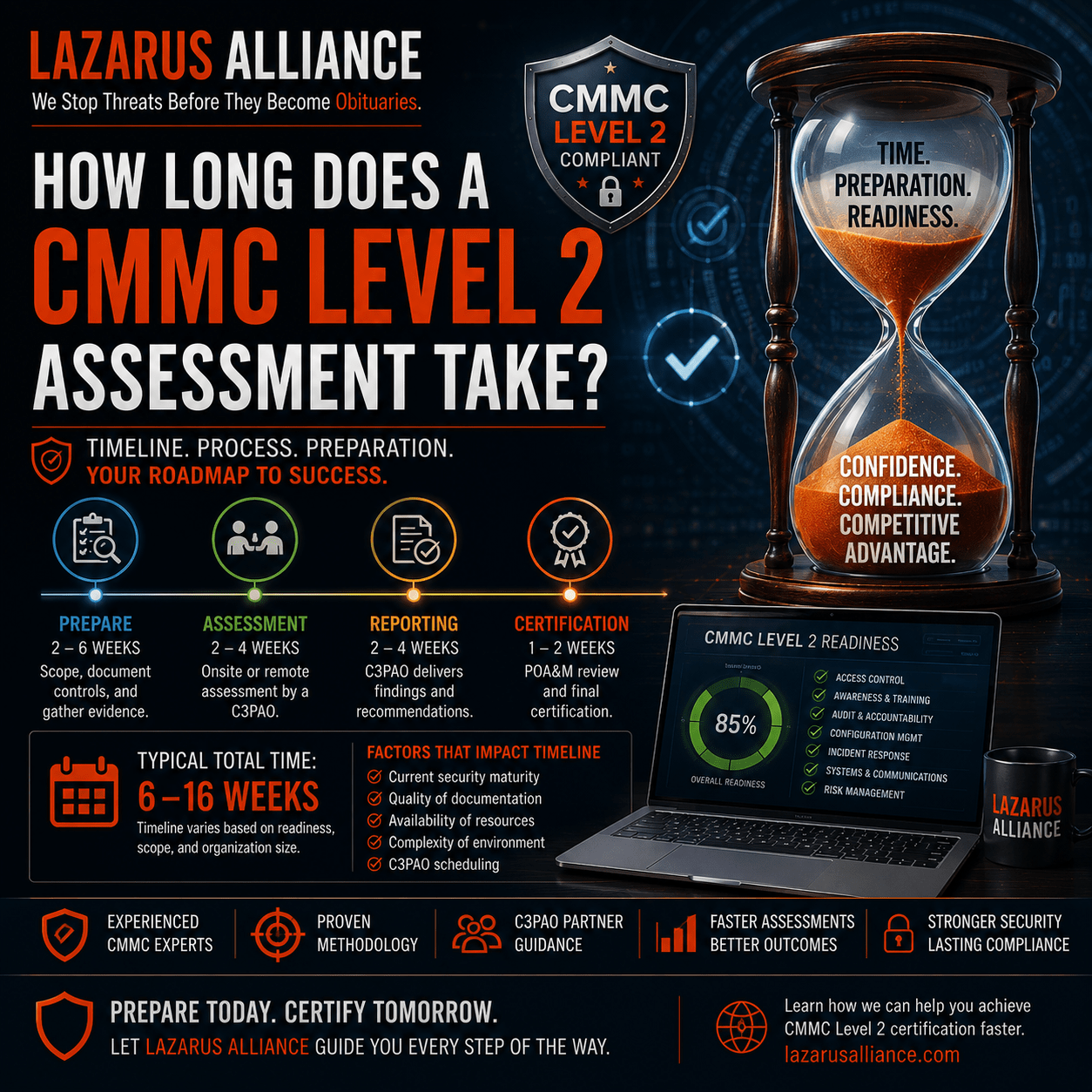
How Long Does a CMMC Level 2
Assessment Take?
Table of Contents
ToggleRealistic Timelines from Lazarus Alliance C3PAO Experience
Based on N = 47 completed formal Level 2 assessments • January 2025 – June 2026 • Updated August 2026
Assessment Duration
(Well-Prepared)
(Incl. Readiness)
On 13 July 2026 the Department of War suspended CMMC Phase II requirements (originally set for 10 November 2026) pending a 60-day reform review. Phase I self-assessment requirements and DFARS 252.204-7012 remain in effect. Voluntary C3PAO assessments and prime-driven requirements continue. Primary sources: DoW Release (13 Jul 2026) · Memo 26-P-1023 (PDF) · DoD CIO CMMC page.
1. What “Assessment Duration” Actually Means
Many organizations confuse two different clocks:
- Formal assessment duration — the period that begins when the C3PAO accepts the evidence package and kicks off the assessment, and ends with delivery of the draft Security Assessment Report (SAR). This is the figure most people mean when they ask “how long does the assessment take.”
- End-to-end engagement — includes readiness/gap analysis, remediation, evidence packaging, the formal assessment itself, POA&M close-out (if any), and final CMMC status. This is typically measured in months.
The benchmarks below focus primarily on the formal assessment phase, drawn from N = 47 completed Lazarus Alliance C3PAO Level 2 assessments conducted between January 2025 and June 2026.
2. Observed Formal Assessment Durations (N = 47)
| Metric | Value | Notes |
|---|---|---|
| Median formal assessment duration | 17 business days | Kickoff → draft SAR |
| 25th percentile | 11 business days | Highly prepared, smaller enclave scopes |
| 75th percentile | 26 business days | |
| Outliers | > 35 business days | Usually multi-site enterprise boundaries or mid-assessment evidence remediation |
| Sample size | N = 47 | Completed formal Level 2 C3PAO assessments only |
Approximate Duration Distribution (N = 47)
3. Typical End-to-End Timeline
While the formal assessment itself is measured in days, the full path to a Final Level 2 status usually looks like this:
| Phase | Typical Duration | What Happens |
|---|---|---|
| Gap analysis / readiness | 4–12 weeks | Scope definition, control mapping, evidence gap identification, remediation planning |
| Remediation & evidence packaging | 4–16 weeks | Close gaps, collect/organize artifacts, internal mock assessment |
| Formal C3PAO assessment | 11–26 business days (median 17) | Evidence review, interviews, testing, draft SAR |
| POA&M close-out (if needed) | Up to 180 days | 74% of assessments in our dataset had at least one POA&M item |
| Final status & affirmation | Days to a few weeks | Certificate issuance / status recording |
Organizations that enter the formal assessment with mature, practice-mapped evidence and a clean enclave frequently complete the entire journey in the lower end of the 3–6 month range. Complex enterprise environments or significant control gaps push timelines toward 7–9+ months.
4. What Drives Longer or Shorter Assessments
Factors that shorten formal assessment duration
- Well-defined CUI enclave with clear data-flow diagrams and enforced segmentation
- Evidence pre-mapped to every Level 2 practice, with timestamps and ownership
- Complete MFA coverage for privileged and remote access paths
- Centralized, reviewable audit logging with adequate retention
- Current, version-controlled configuration baselines
- Prior internal mock assessment that stress-tested the evidence package
- Use of structured GRC tooling (e.g., Continuum GRC / IT Audit Machine®) for continuous evidence
Factors that lengthen formal assessment duration
- Enterprise or multi-site boundary without clear segmentation
- Missing or generic evidence (screenshots without context, policies without operational proof)
- Incomplete MFA, logging, or baseline documentation
- Unsupported inheritance claims lacking customer responsibility matrices or SSP excerpts
- Mid-assessment discovery of significant gaps requiring additional evidence rounds (89% of assessments in the dataset required at least one clarification round)
5. Related Benchmark Findings
From the same N = 47 dataset:
- 66% (31 of 47) used an enclave boundary; these assessments were generally faster
- 74% (35 of 47) resulted in at least one POA&M item (median 3 items when present)
- 89% (42 of 47) required additional evidence after the initial package
- Average evidence volume: ~1,920 artifacts (range ~650–5,800)
Full aggregate data is available in the companion benchmark report and CSV:
6. Practical Tips to Compress the Timeline
- Lock the boundary early. A defended enclave is the single highest-leverage decision for both speed and cost.
- Map every practice to evidence before kickoff. Assessors spend far less time requesting clarification when artifacts are already practice-tagged and contextualized.
- Run a realistic internal mock assessment. Organizations that stress-tested their package needed fewer mid-assessment evidence rounds.
- Prioritize MFA, logging, and baselines. These three areas accounted for a disproportionate share of residual findings and delays.
- Treat POA&Ms as normal. A limited, well-scoped POA&M with rapid close-out is usually faster than attempting zero findings at all costs.
- Use automation where it maintains continuous evidence status rather than one-time document dumps.
7. Authors & How to Cite
Lead Author
Michael D. Peters, CEO & Founder, Lazarus Alliance, Inc.
Authorized CMMC C3PAO leadership; A2LA-accredited FedRAMP 3PAO; PCI DSS QSA firm principal.
How to Cite
Peters, M. D. (2026). How Long Does a CMMC Level 2 Assessment Take? Lazarus Alliance, Inc. Data drawn from the 2026 CMMC Assessment Benchmark Report (N = 47).
8. About Lazarus Alliance
Lazarus Alliance is an authorized CMMC Third-Party Assessment Organization (C3PAO, CPN 10251), an A2LA-accredited FedRAMP 3PAO, a PCI DSS Qualified Security Assessor (QSA), and a veteran-owned small business headquartered in Scottsdale, Arizona. Since 2000 the firm has specialized in proactive cybersecurity, audit, and compliance services.
Lazarus Alliance, Inc.
27743 N. 70th Street, Suite 100, Scottsdale, AZ 85266
1-888-896-7580 • [email protected]
https://lazarusalliance.com
© 2026 Lazarus Alliance, Inc. All rights reserved. Proactive Cybersecurity®, Cybervisor®, and IT Audit Machine® are trademarks of Lazarus Alliance or its affiliates. Benchmark figures are observational aggregates from anonymized assessments and do not guarantee individual timelines or outcomes.
Scottsdale, Arizona • 1-888-896-7580 • lazarusalliance.com
Data Source
This analysis is based on the 2026 CMMC Assessment Benchmark Report, Lazarus Alliance's aggregate analysis of 47 completed formal CMMC Level 2 C3PAO assessments conducted between January 2025 and June 2026.
Additional Analysis
- 7 Most Common CMMC Level 2 Assessment Findings
- How Much Evidence Does a CMMC Assessment Require?
- How Common Are CMMC POA&Ms?
- CMMC Enclave vs Enterprise: What 47 Assessments Show
Talk with one of our experts
Our Lazarus Alliance Cybervisor™ teams have experience performing thousands of assessments for organizations providing services to clients around the world.
We're here to answer any questions you may have.