CJIS v6.1 Gap Assessment: 6 Lazarus Alliance Audit Fixes

CJIS v6.1 Gap Assessment: 6 Lazarus Alliance Audit Fixes

CJIS v6.1 gap assessment work is not a paperwork exercise; it is a control-engineering exercise. The agencies and vendors that will pass scrutiny are the ones that can prove, with defensible evidence, that Criminal Justice Information is identified, isolated, encrypted, monitored, governed, and continuously tested across the full technology supply chain.

The practical shift is that CJIS compliance now looks much more like a structured NIST 800-53 assessment than a legacy checklist. According to reporting on the current policy release, FBI CJIS Security Policy v6.1 was published on June 25, 2026, and the modernization moves CJIS toward a control-based structure closely aligned with NIST SP 800-53; the same report notes updates including stronger symmetric encryption expectations and more frequent vulnerability scanning BleepingComputer, FBI’s CJIS v6.1: What Security Teams Need to Know. The FBI also maintains the official CJIS Security Policy Resource Center for policy resources and related materials FBI, CJIS Security Policy Resource Center.

For CISOs, compliance officers, IT directors, law-enforcement technology suppliers, and cloud service providers, the winning strategy is a focused CJIS v6.1 gap assessment mapped to NIST 800-53, with evidence that can be reused for SOC 2, FedRAMP, CMMC, DFARS NIST 800-171, PCI DSS, HIPAA, IRS 1075, C5, GovRAMP, ISO 27001, and LA DMF programs. Lazarus Alliance supports CJIS-focused readiness through its criminal justice information services audit and compliance practice Lazarus Alliance, CJIS Services and NIST 800-53/FISMA assessment services Lazarus Alliance, FISMA and NIST Audit Services.
Read More

GovRAMP and C5 Cloud Audit: 8 Lazarus Alliance Steps

GovRAMP and C5 Cloud Audit: 8 Lazarus Alliance Steps

Public-sector cloud assurance is no longer a single certification project. It is an evidence operating model. A cloud service provider that sells to agencies, education, defense-adjacent buyers, healthcare programs, justice organizations, or European regulated entities may need to satisfy GovRAMP, BSI C5, FedRAMP, NIST 800-53, SOC 2, ISO 27001, HIPAA, PCI DSS, CJIS, IRS 1075, DFARS NIST 800-171, CMMC, and customer-specific procurement clauses with the same underlying control environment. The strategic mistake is treating each framework as a separate audit. The efficient approach is to build one defensible control architecture, one evidence fabric, and one continuous monitoring cadence that can be expressed in the language of each assurance regime.

That is the operating premise behind Lazarus Alliance’s eight-step method for GovRAMP and BSI C5 cloud audit readiness. The objective is not merely to pass an assessment. The objective is to make cloud compliance durable, repeatable, machine-readable where possible, and useful to executive decision-makers.

Read More

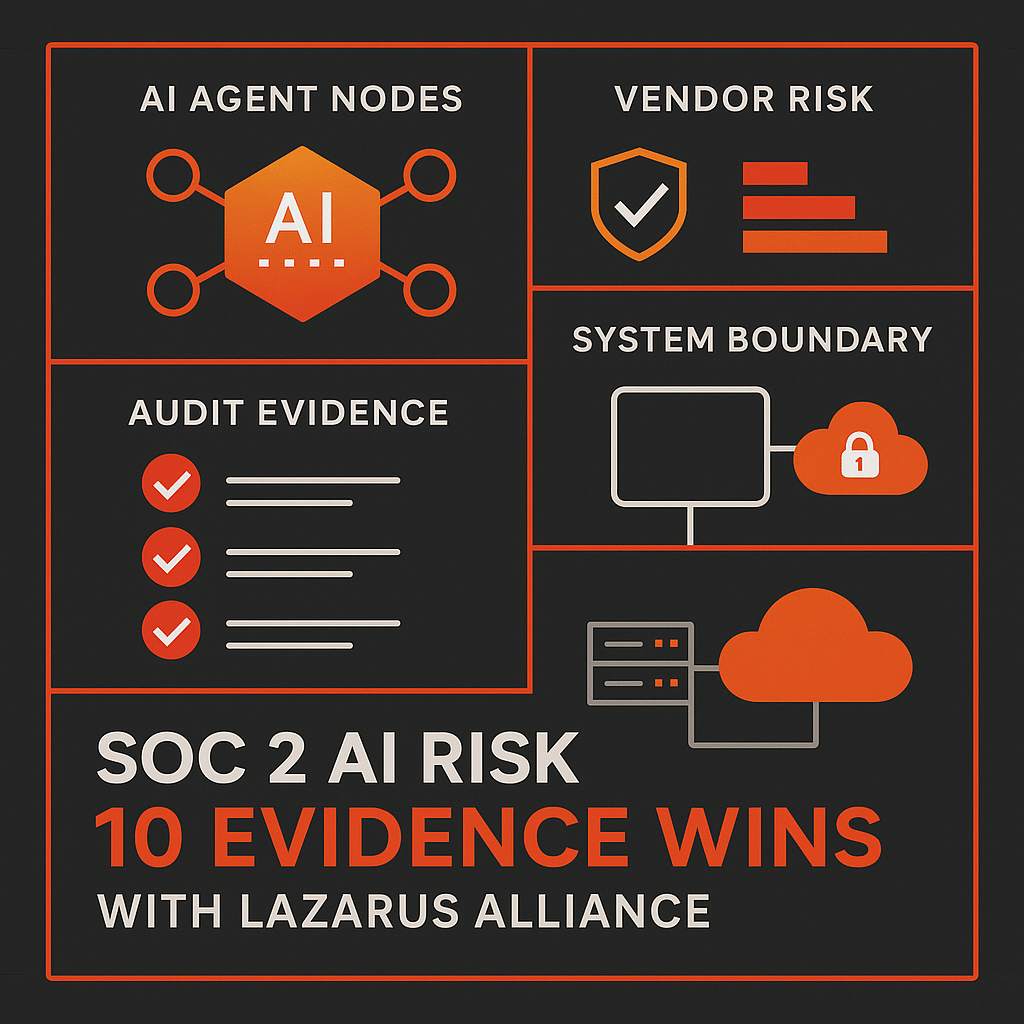
SOC 2 AI Risk: 10 Evidence Wins with Lazarus Alliance

SOC 2 AI Risk: 10 Evidence Wins with Lazarus Alliance

The hardest SOC 2 AI risk problem is not whether an AI tool is innovative; it is whether the auditor can see where the tool starts, what it can touch, who owns it, and what evidence proves it behaved as intended. AI agents, embedded copilots, retrieval-augmented generation, automated support bots, and vendor-hosted models create a new evidence challenge: they often act like users, integrations, processors, and decision engines at the same time.

For Lazarus Alliance, the practical answer is not to bolt a vague AI policy onto a SOC 2 audit. The answer is to convert AI risk into testable audit evidence mapped to system boundaries, vendor risk management, access control, logging, change management, privacy, confidentiality, and customer assurance. The AICPA explains that SOC 2 description criteria support evaluation of a service organization’s system across security, availability, processing integrity, confidentiality, and privacy, which means AI capabilities must be described and evidenced when they are relevant to the service commitment or system boundary AICPA & CIMA, SOC 2 Description Criteria.

This article gives CISOs, compliance officers, IT directors, and audit owners a field-tested evidence model: 10 SOC 2 evidence wins for AI agents, AI vendors, and AI system boundaries.

Read More