The stunning reality is that the majority of retailers accepting credit cards are still vulnerable to the newest threat to accepting credit cards from consumers. Lazarus Alliance has been years ahead with proactive cybersecurity services.
Researchers from the Cisco Security Solutions team have dubbed the latest malware to attack point-of-sales (POS) systems PoSeidon. Compromised POS systems are vulnerable to these attacks, which allow the RAM of an infected terminal to be scanned by the malware. PoSeidon looks for unencrypted credit card data and then transmits that data out to an exfiltration server controlled by the cyber criminals.
This technique has long been known to security experts. The Proactive Cybersecurity™ services at Lazarus Alliance have been years ahead of this issue by offering solutions to companies that utilize POS systems that ensure this memory scraping technique does not compromise a payment process.
William Ochs, GRC Partner of Lazarus Alliance, said, “Not only has Lazarus Alliance long called for end-to-end encryption technology to be utilized to mitigate the risk posed by POS threats, but Lazarus Alliance also has a proven track record of offering actual solutions to implement end-to-end encryption protecting retailers globally.”
As long as organizations remain reactive instead of proactive in their approach to cybersecurity, they will continue to fail the constituents they work to protect. The PoSeidon POS malware program is another example in a daunting list of the challenges that face organizations concerned with their PCI DSS stance.
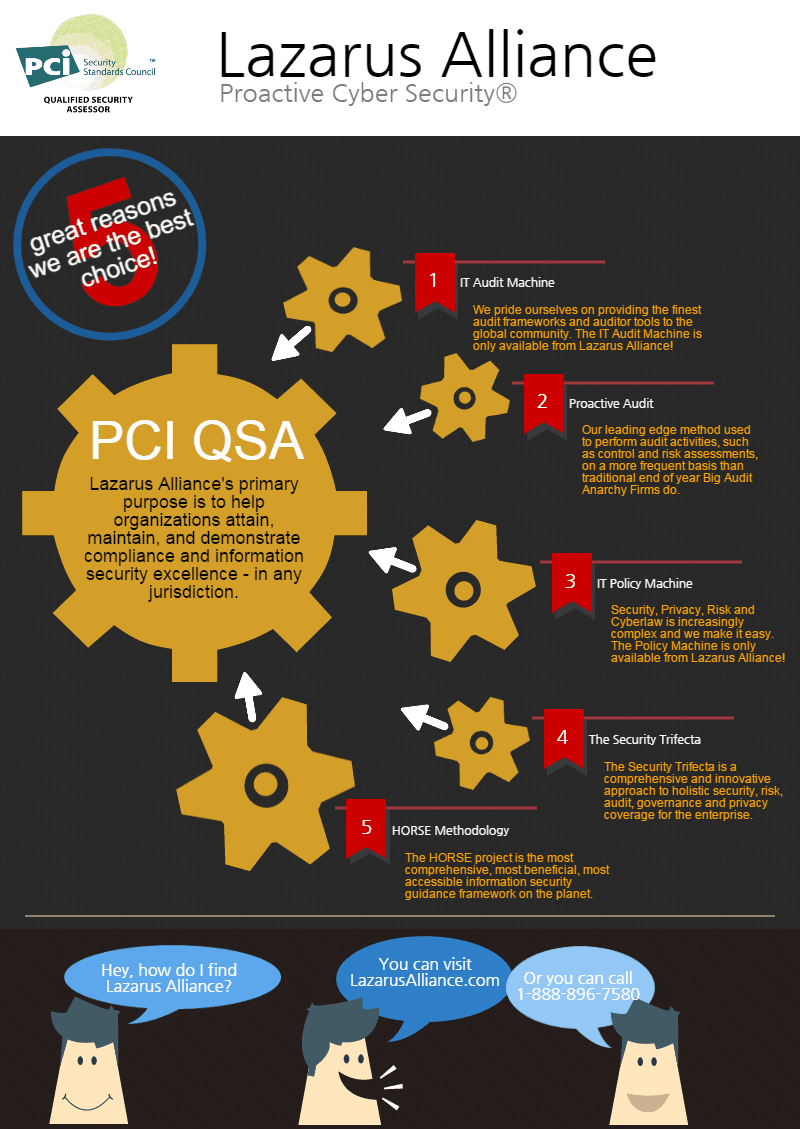
As a PCI DSS audit Qualified Security Assessor (QSA) company, Lazarus Alliance has been approved by the PCI Security Standards Council (SSC) to measure an organization’s compliance to the PCI DSS audit standard. Lazarus Alliance specializes in providing our clients with scalable, efficient solutions for meeting the rigorous demands of Payment Card Industry (PCI) compliance. We do this in part because of our breakthrough proprietary technologies called the IT Audit Machine (ITAM) and the Policy Machine.
“It’s incumbent upon security professionals to proactively advocate for best practices in cybersecurity, risk, and compliance; too often, the opposite occurs in the industry,” said Ochs
Learn more about Lazarus Alliance and why Lazarus Alliance is Proactive Cybersecurity™!
We’re reaching the end of 2025, and looking ahead to 2026, most experts are discussing the latest threats that will shape the year ahead. This year, we’re seeing a new, but not unexpected, shift to autonomous threats driven by state-sponsored actors and AI. With that in mind, a new generation of threats, broadly known as...Continue reading→
In mid-October 2025, the CISA issued one of its most urgent orders yet: Emergency Directive 26-01. The directive calls on all Federal Civilian Executive Branch (FCEB) agencies to immediately mitigate vulnerabilities in devices from F5 Networks following a state-sponsored breach of F5’s systems and access to portions of BIG-IP source code and vulnerability data. The event...Continue reading→
A recent exploit involving a new AI-focused browser shone a light on a critical problem–namely, that browser security is a constant issue, and AI is just making that threat more pronounced. Attackers discovered a way to use that browser’s memory features to implant hidden instructions inside an AI assistant. Once stored, those instructions triggered unwanted...Continue reading→
When the federal government shuts down, the public sees closed monuments, unpaid workers, and halted programs. What they do not see is the silent surge of cyberattacks targeting agencies already operating on fumes. During the most recent shutdown, attacks against U.S. government systems spiked by nearly 85%. Cybersecurity failures during government disruptions rarely start with...Continue reading→
The world of cyber threats is rapidly evolving, and while we can see these changes more generally, it’s always crucial to understand them concretely. As the 2025 CrowdStrike Global Threat Report shows us, the landscape of our industry is changing. We’re digging into this report to discuss a challenging trend: the move of hackers foregoing...Continue reading→
The increasing adoption of AI by businesses introduces security risks that current cybersecurity frameworks are not prepared to address. A particularly complex emerging threat is prompt injection attacks. These attacks manipulate the integrity of large language models and other AI systems, potentially compromising security protocols and legal compliance. Organizations adopting AI must have a plan...Continue reading→
The ink has barely dried on the CMMC final rule, and already the defense contracting community is buzzing with speculation about what comes next. Just when contractors thought they had a moment to catch their breath after years of regulatory limbo, whispers of CMMC 3.0 have begun circulating through the industry. But is this just...Continue reading→
As the traditional network boundary dissolves and remote work becomes standard practice, identities are the major frontier for security. Whether we’re talking about human users, service accounts, or machine identities, these have emerged as both the primary access mechanism and the most targeted attack vector. It has become imperative for providers to centralize identity management...Continue reading→
FedRAMP provides a standardized approach to security assessment, authorization, and continuous monitoring for cloud products and services used by federal agencies. While the program’s rigorous baseline requirements ensure consistent security, the reality is that this consistency calls for a little flexibility. This is where deviation requests and significant change requests come into play. These two...Continue reading→
Data is possibly one of the most valuable assets any organization holds. Customer information, employee records, and proprietary business intelligence present challenges because the data flowing through modern enterprises represents both significant opportunities and serious risks. Businesses face a challenging balance: investing in compliance measures to protect sensitive information while also preparing for the real...Continue reading→