
Why Excel is so Old-School and how to be Cool-School

Cool School -vs- Old School compares assessments done with Excel and the IT Audit Machine.
We get it. We completely understand why you still use Excel as an assessment and audit tool. We suffered through it just the same but we believe that working smarter and not harder which is why we invented ITAM.

The IT Audit Machine (ITAM) is the patent pending, industry changing assessment questionnaire creation tool designed specifically for the governance, risk and compliance (GRC) market space but where infinite possibilities exist even outside of the GRC and cybersecurity realms due to the intelligence and simplicity of the patent pending ITAM application framework.

Typical usage includes Audit and Compliance Assessments associated with FedRAMP, PCI DSS, HIPAA, Sarbanes Oxley, ISO 27001 and all others; Risk Management Assessments associated with ISO 27005, NIST Special Publications and all others; and Governance and Policy Development to describe a few but not all possible use cases.

Excel has big limits in space, accessibility, presentation, sustainability and formatting making it a poor choice for assessment and audit work. ITAM has flipped that paradigm upside-down with Big Data management, collaborative SaaS access, theme driven aesthetics, long term analytics and trending functionality, intelligent logic and notifications and so much more.

Our GRC solutions break industry paradigms that have plagued both client organizations and service providers alike. We’d like to show you how we have taken our real-world expertise and created GRC solutions that are being touted as game-changing technology. Call Continuum GRC software solutions today at 1-888-896-7580 and schedule a demonstration.

Simply put, Excel is so old-school and ITAM is so cool-school!

Visit ContinuumGRC.com to get more information about the IT Audit Machine.
New PoSeidon Adventure is a POS Malware Threat to Retailers

The stunning reality is that the majority of retailers accepting credit cards are still vulnerable to the newest threat to accepting credit cards from consumers. Lazarus Alliance has been years ahead with proactive cybersecurity services.

Researchers from the Cisco Security Solutions team have dubbed the latest malware to attack point-of-sales (POS) systems PoSeidon. Compromised POS systems are vulnerable to these attacks, which allow the RAM of an infected terminal to be scanned by the malware. PoSeidon looks for unencrypted credit card data and then transmits that data out to an exfiltration server controlled by the cyber criminals.

New malware program PoSeidon targets point-of-sale systems. Lazarus Alliance PCI QSA services protect clients against it.

This technique has long been known to security experts. The Proactive Cybersecurity™ services at Lazarus Alliance have been years ahead of this issue by offering solutions to companies that utilize POS systems that ensure this memory scraping technique does not compromise a payment process.

William Ochs, GRC Partner of Lazarus Alliance, said, “Not only has Lazarus Alliance long called for end-to-end encryption technology to be utilized to mitigate the risk posed by POS threats, but Lazarus Alliance also has a proven track record of offering actual solutions to implement end-to-end encryption protecting retailers globally.”

As long as organizations remain reactive instead of proactive in their approach to cybersecurity, they will continue to fail the constituents they work to protect. The PoSeidon POS malware program is another example in a daunting list of the challenges that face organizations concerned with their PCI DSS stance.

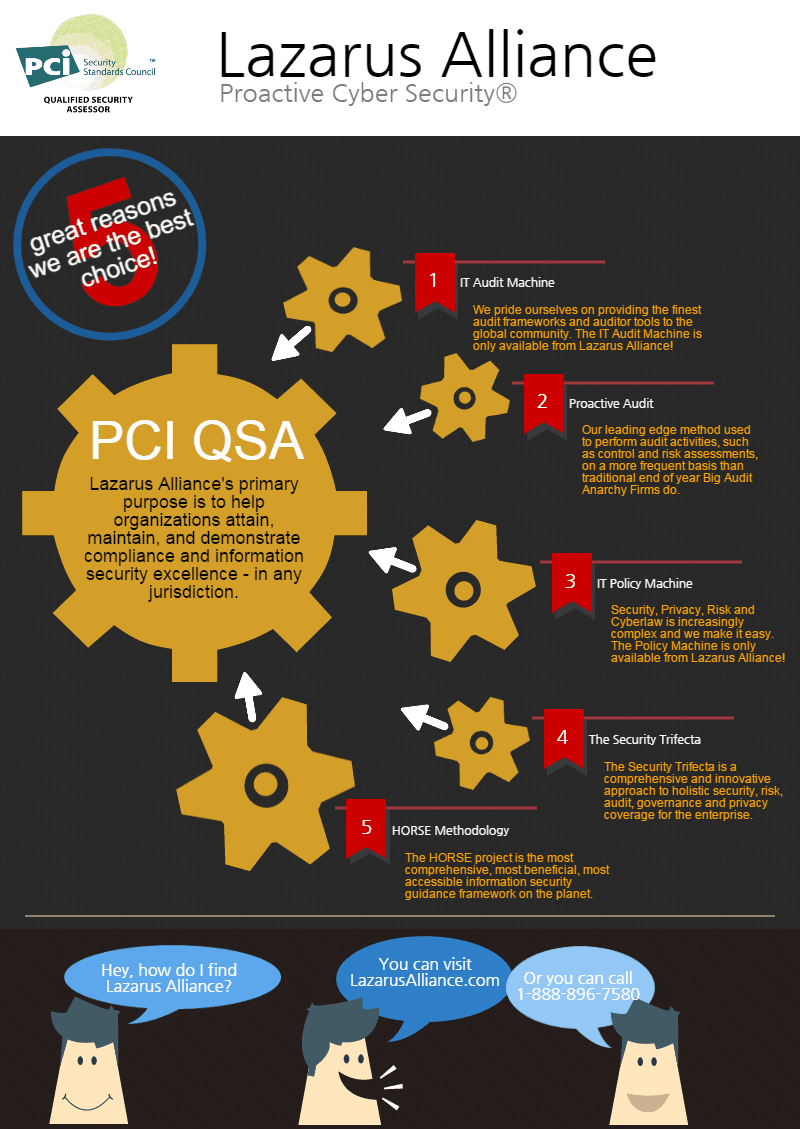
As a PCI DSS audit Qualified Security Assessor (QSA) company, Lazarus Alliance has been approved by the PCI Security Standards Council (SSC) to measure an organization’s compliance to the PCI DSS audit standard. Lazarus Alliance specializes in providing our clients with scalable, efficient solutions for meeting the rigorous demands of Payment Card Industry (PCI) compliance. We do this in part because of our breakthrough proprietary technologies called the IT Audit Machine (ITAM) and the Policy Machine.

“It’s incumbent upon security professionals to proactively advocate for best practices in cybersecurity, risk, and compliance; too often, the opposite occurs in the industry,” said Ochs

Learn more about Lazarus Alliance and why Lazarus Alliance is Proactive Cybersecurity™!

Proactive vs Reactive Cyber Security on Money Radio

Recently Michael Peters, CEO of Lazarus Alliance, spent time with David Cogan of Money Radio and eLiances discussing the differences between proactive cybersecurity and reactive cybersecurity. You can replay the broadcast as heard on money radio.

Michael Peters and David Cogan as heard on Money Radio

An overview of the discussion was when you think cybersecurity, what comes to your mind first?

I’ve posed that question to many an audience over the years and most frequently the response is what folks see on the nightly news or through some new source. Recently people will respond with examples such as Home Depot, Target, Sony, JP Morgan and the European Central Bank which of course are just a few of the most notable instances of breaches we seen in the news over the last twelve months.

I point out to these same groups that in reality, there are only two forms of cybersecurity and its Proactive Cybersecurity and Reactive Cybersecurity. I’ll explain what that means and let’s see if you agree.

Reactive Cybersecurity situations are going to be in the news because something bad has happened. Reactive security companies help you clean up the mess. When you become aware of a cybersecurity breach at some company, it’s probably because you are watching the business catastrophe unfolding through some syndication source. You eventually get a notification by the company, your bank or credit card provider informing you that your private and personal information has been stolen which leaves you to worry and watch hoping that nothing bad happens to you.

From a business standpoint, it has become painfully obvious at all levels including shareholders that cyber breaches have a really negative impact on business value not to mention careers of everyone involved especially at the highest levels of the company. We have all seen for the first time in 2014 CEOs, CIOs and CISOs losing their jobs as a direct result of culpability or negligence on their part.

No doubt about it, cybersecurity breaches have a hugely negative impact on the financial health and reputation of the victim company.

So this brings me to the second form of cybersecurity which is proactive cybersecurity. Proactive Cybersecurity is all about keeping you out of the news by implementing the right controls and countermeasures. We know it’s not enough for the government or the private sector to have rules and regulations. PCI DSS certification did not save Target, Home Depot or other retailers. The FFIEC or the NIST Framework for Improving Critical Infrastructure Cybersecurity did not save JP Morgan or other financial institutions from their breaches.

You need qualified assistance to make it effective. It’s tough when there are not enough talented cybersecurity professionals to go around. Businesses are short-staffed. Academia is not training and educating enough to keep up with the demand.

The best possible course of action to avoid being the latest corporate cybersecurity breach is to take a proactive approach. I’m the CEO and Lazarus Alliance is Proactive Cybersecurity™.

Be sure to check out the dynamic group of hybrid entrepreneurs who spend time together at eLiances where entrepreneurs align hosted by David Cogan.

Michael Peters and David Cogan of eLiances

Thank you to Money Radio for inviting me to discuss the differences between Proactive and Reactive Cybersecurity.

Michael Peters and David Cogan as heard on Money Radio