Lazarus Alliance SSAE 16 Assessment Services
From SSAE 16 Audits to IT Security Consulting, the experts at Lazarus Alliance provide a variety of services to fulfill your audit needs. SOC 1, SOC 2 and SOC 3: We are ready when you are!
Lazarus Alliance is completely committed to you and your business success. Regardless of whether you represent the private sector or the public sector, we stand ready to partner with your organizations. Our competition may want to keep you and your employees in the dark where security, risk, privacy and governance are concerned hoping to conceal their methodology and expertise. We don’t prescribe to that philosophy. We believe the best approach is transparent and built on a partnership developed on trust and credibility creating sustainability within your organization.
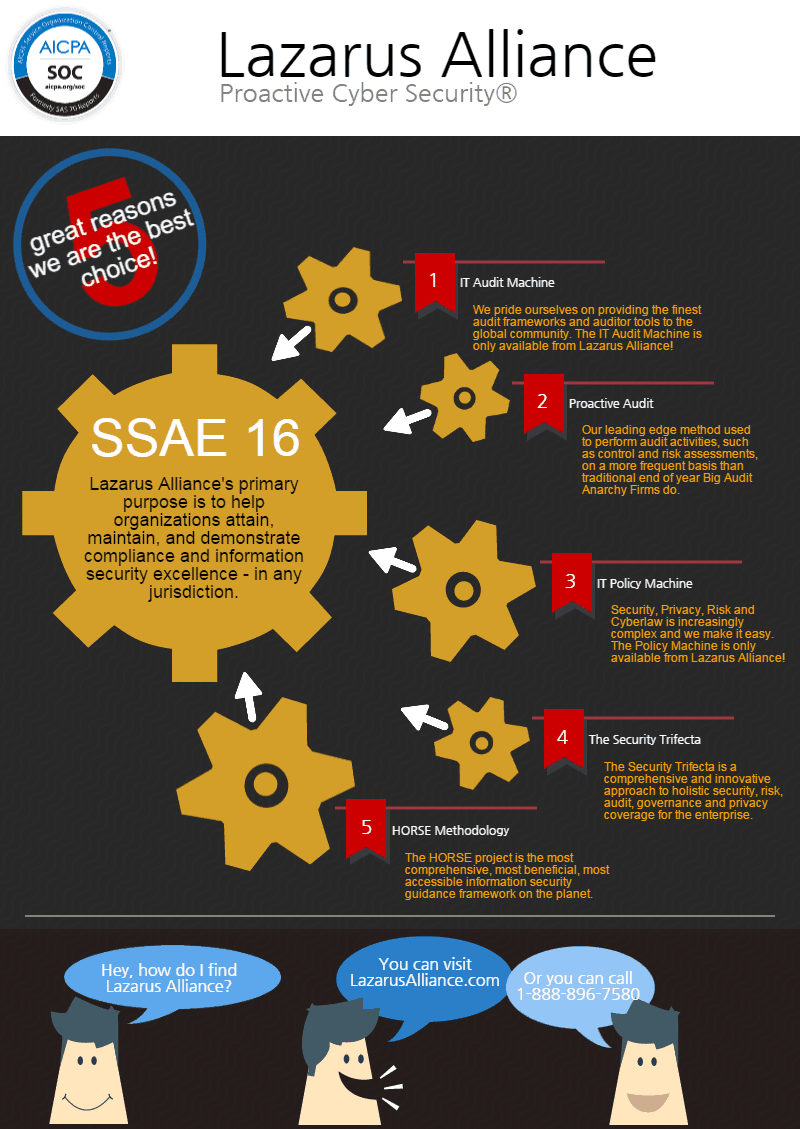
Lazarus Alliance’s primary purpose is to help organizations attain, maintain, and demonstrate compliance and information security excellence – in any jurisdiction. Lazarus Alliance specializes in IT security, risk, privacy, governance,cyberspace law and compliance leadership solutions and is fully dedicated to global success in these disciplines.
Certifications Overview
SOC 1: Once a company has made the decision to enlist a third party to provide a service, they want assurances that those services will be provided timely, accurately, and securely. A SSAE 16 audit shows your commitment to maintaining a sound control environment that protects your client.s data and confidential information.
Not sure which report is right for your organization? Ask yourself these questions:
Will the report be used by your customers and their auditors to plan or perform an audit of their financial statements? If so, then the SOC 1 report is right for you.
SOC 2 and SOC 3: Service Organization Controls (SOC) 2 and 3 reports are designed to provide comfort over the following principles: Security, Confidentiality, Processing Integrity, Availability, and Privacy (if applicable) of a System in-scope. A System is holistically comprised of the Technology, People, Processes, and Data used to complete the services provided.
The following is a brief description of the goals to be achieved with each principle:
- Security: The system is protected against unauthorized access (both physical and logical).
- Confidentiality: Information designated as confidential is protected as committed or agreed.
- Processing Integrity: System processing is complete, accurate, timely, and authorized.
- Availability: The system is available for operation and use as committed or agreed.
- Online Privacy: Personal information obtained as a result of e-commerce is collected, used, disclosed, and retained as committed or agreed.
Still not sure which report is right for your organization? Ask yourself these questions:
Will the report be used by your customers or stakeholders to gain confidence and place trust in a service organization’s systems? If so, then the SOC 2 or SOC 3 report is right for you.
or
Do you need to make the report generally available or seal? If so, then the SOC 3 report is right for you.
We want to be your partner. For additional information please contact us!
We’re reaching the end of 2025, and looking ahead to 2026, most experts are discussing the latest threats that will shape the year ahead. This year, we’re seeing a new, but not unexpected, shift to autonomous threats driven by state-sponsored actors and AI. With that in mind, a new generation of threats, broadly known as...Continue reading→
In mid-October 2025, the CISA issued one of its most urgent orders yet: Emergency Directive 26-01. The directive calls on all Federal Civilian Executive Branch (FCEB) agencies to immediately mitigate vulnerabilities in devices from F5 Networks following a state-sponsored breach of F5’s systems and access to portions of BIG-IP source code and vulnerability data. The event...Continue reading→
A recent exploit involving a new AI-focused browser shone a light on a critical problem–namely, that browser security is a constant issue, and AI is just making that threat more pronounced. Attackers discovered a way to use that browser’s memory features to implant hidden instructions inside an AI assistant. Once stored, those instructions triggered unwanted...Continue reading→
When the federal government shuts down, the public sees closed monuments, unpaid workers, and halted programs. What they do not see is the silent surge of cyberattacks targeting agencies already operating on fumes. During the most recent shutdown, attacks against U.S. government systems spiked by nearly 85%. Cybersecurity failures during government disruptions rarely start with...Continue reading→
The world of cyber threats is rapidly evolving, and while we can see these changes more generally, it’s always crucial to understand them concretely. As the 2025 CrowdStrike Global Threat Report shows us, the landscape of our industry is changing. We’re digging into this report to discuss a challenging trend: the move of hackers foregoing...Continue reading→
The increasing adoption of AI by businesses introduces security risks that current cybersecurity frameworks are not prepared to address. A particularly complex emerging threat is prompt injection attacks. These attacks manipulate the integrity of large language models and other AI systems, potentially compromising security protocols and legal compliance. Organizations adopting AI must have a plan...Continue reading→
The ink has barely dried on the CMMC final rule, and already the defense contracting community is buzzing with speculation about what comes next. Just when contractors thought they had a moment to catch their breath after years of regulatory limbo, whispers of CMMC 3.0 have begun circulating through the industry. But is this just...Continue reading→
As the traditional network boundary dissolves and remote work becomes standard practice, identities are the major frontier for security. Whether we’re talking about human users, service accounts, or machine identities, these have emerged as both the primary access mechanism and the most targeted attack vector. It has become imperative for providers to centralize identity management...Continue reading→
FedRAMP provides a standardized approach to security assessment, authorization, and continuous monitoring for cloud products and services used by federal agencies. While the program’s rigorous baseline requirements ensure consistent security, the reality is that this consistency calls for a little flexibility. This is where deviation requests and significant change requests come into play. These two...Continue reading→
Data is possibly one of the most valuable assets any organization holds. Customer information, employee records, and proprietary business intelligence present challenges because the data flowing through modern enterprises represents both significant opportunities and serious risks. Businesses face a challenging balance: investing in compliance measures to protect sensitive information while also preparing for the real...Continue reading→