


















































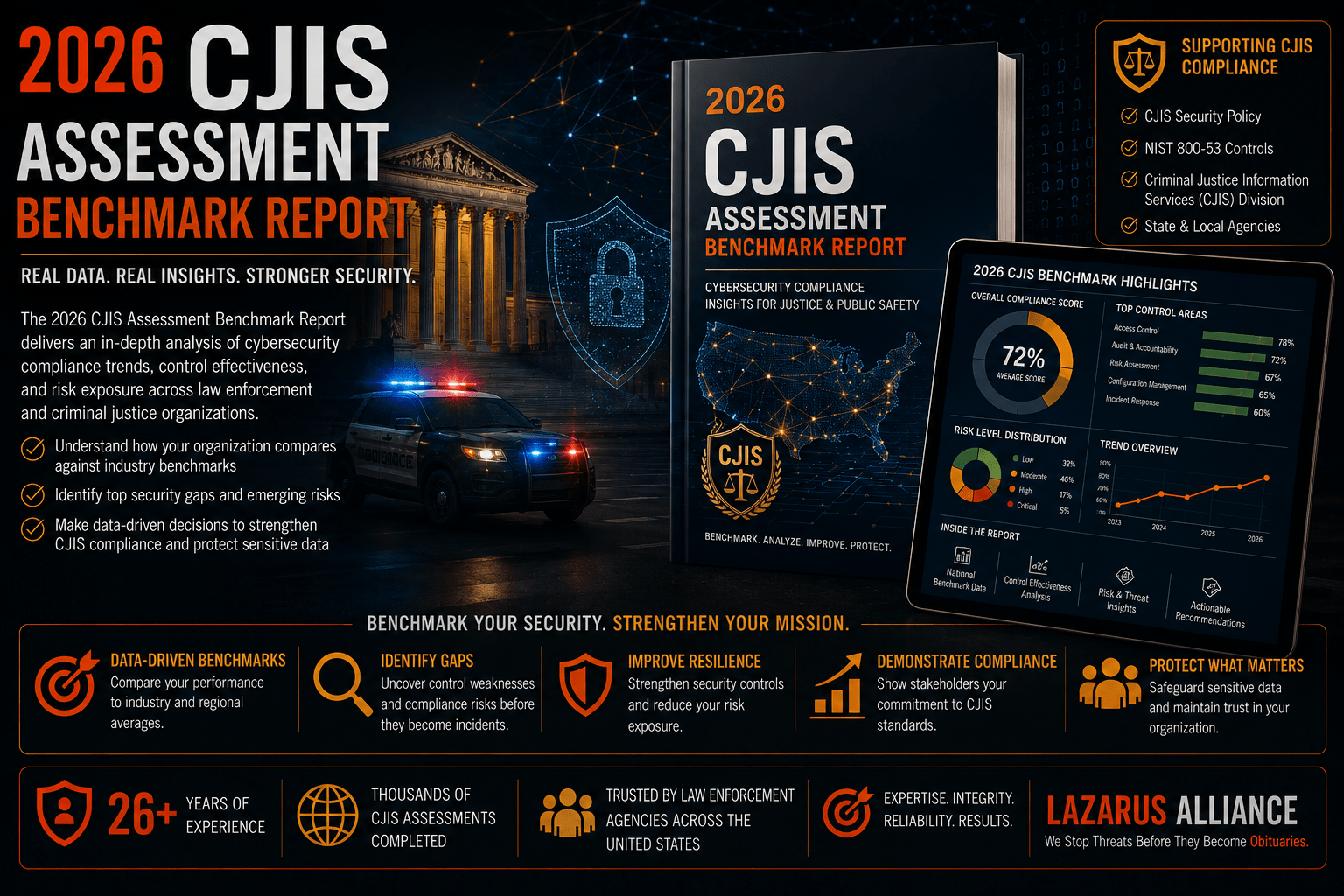
Contrarian audit insight: most CJIS compliance failures are not caused by an agency having no encryption. They occur because encryption is implemented unevenly, documented loosely, or excluded from monthly vulnerability scanning evidence. CJIS v6.1 raises the practical bar for criminal justice agencies, cloud service providers, SaaS platforms, managed service providers, and contractors that create, receive, store, process, or transmit Criminal Justice Information. The audit question is no longer simply whether encryption exists. The stronger question is whether encryption is complete, cryptographically defensible, continuously monitored, and provable.
For CISOs and compliance officers, CJIS v6.1 should be treated as a control-evidence modernization project. Encryption architecture, vulnerability scanning, patch governance, key management, cloud configuration, remote access, backups, and third-party connectivity all need to produce repeatable evidence. Lazarus Alliance approaches CJIS compliance assessments with that evidence-first mindset, aligning CJIS requirements to broader security control families such as NIST 800-53 security assessment, risk assessment, system and communications protection, access control, audit logging, and configuration management.