
StateRAMP - GovRAMP Authorization & 3PAO Audit Services | Fast-Track Compliance for Cloud Providers. Call +1 (888) 896-7580 today.
StateRAMP, operating as GovRAMP since its rebranding in February 2025, is a 501(c)(6) nonprofit membership organization established in 2021 to standardize and streamline the cybersecurity assessment, authorization, and continuous monitoring of cloud service offerings (CSOs) for state, local, tribal, and education (SLED) governments in the United States. Modeled after the federal FedRAMP program, it addresses the unique needs of subnational governments by providing a "verify once, serve many" framework that reduces duplication in security evaluations, lowers costs for cloud service providers (CSPs), and enables faster, more secure cloud adoption for public sector entities handling sensitive data like PII, financial records, and critical infrastructure information.
The program promotes cybersecurity best practices through policy development, education, and collaboration among governments, CSPs, and third-party assessment organizations (3PAOs). It is not affiliated with or endorsed by FedRAMP or the U.S. federal government, but it aligns closely with federal standards like NIST SP 800-53 Rev. 5 to ensure interoperability where possible. As of December 2025, GovRAMP has gained traction with over 23 states mandating or recognizing it.
Purpose
- For Governments: Simplifies procurement by offering a trusted, reusable validation of CSP security postures, reducing "data sprawl" and cyber risks while addressing diverse state-specific standards.
- For CSPs: Provides transferable compliance credentials, minimizing the time, cost, and complexity of meeting fragmented SLED requirements.
- Overall: Enhances public sector cyber resilience amid rising threats, fostering trust between private-sector providers and government entities.
StateRAMP emerged in 2021 as a response to the federal FedRAMP's success, adapting its model for SLED environments where agencies lacked resources for full independent assessments. It began with a focus on state-level standardization and has since expanded to include tribal and educational institutions. The 2025 rebranding to GovRAMP reflects its broader "whole-of-government" mission, encompassing not just states but also local, tribal, and higher education sectors—without overlapping federal GovRAMP (a separate federal high-impact program).
Authorization Levels
GovRAMP defines four primary impact levels based on NIST FIPS 199 (Low: limited adverse impact; Moderate: serious; High: severe/catastrophic), with controls from NIST SP 800-53 Rev. 5 plus GovRAMP-specific overlays. Authorizations result in statuses like Ready (self-attested or light audit), Provisional (P-ATO equivalent), or Authorized (full ATO with continuous monitoring).
| Impact Level | Baseline Controls (Approx.) | Key Use Cases | Reuse Scope |
|---|---|---|---|
| Low | ~125 NIST 800-53 Low controls | Public/low-sensitivity data (e.g., general websites, public info portals) | SLED entities nationwide |
| Low+ | Enhanced Low (~150 controls) | Slightly elevated low-risk data (e.g., basic admin tools; unique to GovRAMP) | SLED entities nationwide |
| Moderate | ~325 NIST 800-53 Moderate controls + overlays | Confidential data (e.g., PII, financial/health records) | SLED entities nationwide |
| High | ~421 NIST 800-53 High controls + overlays | High-sensitivity data (e.g., critical infrastructure, law enforcement) | SLED entities nationwide |
| Core (Intro May 2025) | 60 foundational Moderate controls (MITRE ATT&CK mapped) | Entry-level validation for progressing products toward full authorization | Broad pre-authorization access for SLED |
Assessment Process
CSPs undergo independent audits by accredited 3PAOs like Lazarus Alliance. Paths include agency-sponsored or provisional authorizations, followed by continuous monitoring (e.g., monthly vulnerability scans, quarterly reports).
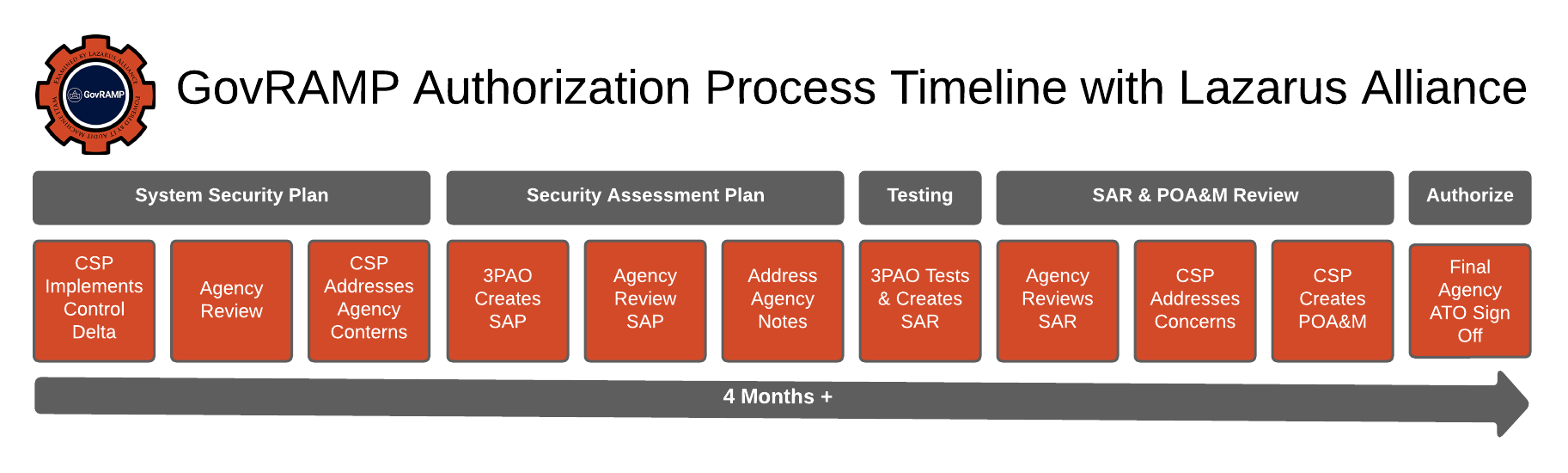
GovRAMP Authorization Audit Timeline: What to Expect with Lazarus Alliance
GovRAMP (formerly StateRAMP) is a standardized framework for assessing and authorizing cloud service providers (CSPs) to deliver secure cloud services to state and local governments. It aligns closely with FedRAMP but focuses on state-level procurement, enabling faster approvals through reciprocal authorizations. As an accredited Third-Party Assessment Organization (3PAO) by A2LA and the GovRAMP PMO, Lazarus Alliance specializes in these audits, leveraging their "critical path methodology," proactive philosophy, and tools like the Continuum GRC ITAM platform to streamline the process. This approach typically reduces traditional assessment timelines by 46%, making the overall journey from kickoff to Authority to Operate (ATO) more efficient.
The full GovRAMP authorization process generally spans 12-18 months for most CSPs, depending on system complexity, baseline level (Moderate or High), and internal readiness. However, Lazarus Alliance emphasizes early gap analysis and readiness to accelerate this. Post-authorization, continuous monitoring (ConMon) is required, involving monthly vulnerability scans, quarterly reports, and annual reassessments to maintain status.
Key Phases and Timeline
Here's a breakdown of the typical phases when partnering with Lazarus Alliance as your 3PAO. Timelines are based on their documented averages for 2024-2025 engagements and assume an agency-sponsored ATO path (the most common route). Provisional authorization paths can be faster but require JAB review.
| Phase | Description | Typical Duration | Key Lazarus Alliance Activities |
|---|---|---|---|
| 1. Decision & Partner Selection | Evaluate if GovRAMP fits your business needs; select a 3PAO and sponsoring agency. | 1-2 months | Cybervisors™ conduct initial consultations (several days of analysis) to define system boundaries, estimate costs, timelines, and resource needs. Sign the contract and roadmap development. |
| 2. Gap Analysis & Compliance Review | Identify deviations from NIST 800-53 Rev 5 controls (tailored to GovRAMP baseline). Review policies, procedures, and high-value controls. | 1-2 months | Technical review of vulnerabilities, penetration testing applicability, and control status. Use the ITAM platform for automated evidence collection to baseline your organization quickly. |
| 3. Readiness Assessment | Simulate the full audit to confirm controls are designed and implemented effectively. Produces a Readiness Assessment Report (RAR). | 2-3 months | Full walkthrough of controls; address POA&Ms (Plans of Action and Milestones). Lazarus's methodology here cuts time by focusing on critical paths, ensuring fast progression to formal audit. |
| 4. Full 3PAO Assessment | Independent security assessment, including interviews, testing, and documentation review. Generates Security Assessment Report (SAR) and supporting artifacts (e.g., SSP - System Security Plan). | 3-6 months | On-site/remote audits with 24/7 ITAM access for efficient collaboration. Verify compliance across SaaS, PaaS, or IaaS offerings; includes vulnerability scans and pen testing. |
| 5. Authorization Package Review & ATO | Submit the package to the sponsoring agency and the GovRAMP Marketplace for review. Agency issues ATO. | 2-3 months | Lazarus supports package preparation and remediation of findings. Faster with their 46% time reduction via proactive tools. |
| 6. Continuous Monitoring (Post-ATO) | Ongoing compliance to retain authorization; annual reassessment required. | Ongoing (starts immediately) | Monthly scans, quarterly reporting, and annual audits via ITAM. Helps maintain audit trails without last-minute hassles. |
What to Expect During the Process
- Preparation and Collaboration: Expect heavy involvement from your internal teams (e.g., IT, security, compliance) for evidence gathering. Lazarus Alliance's ITAM SaaS automates much of this, providing real-time transparency and reducing manual work. Kickoff meetings focus on aligning on the authorization boundary and high-value controls.
- Audits and Testing: Assessments involve document reviews, control testing, interviews, and scans. Lazarus's "proactive cybersecurity" approach means they're hands-on, helping remediate issues in real-time to avoid delays.
- Challenges and Mitigations: Common hurdles include POA&M delays or incomplete evidence—Lazarus mitigates these with templates, A.ITAMBot for automation, and their expertise in hybrid cloud environments. Overall costs and internal demands are outlined upfront by Cybervisors™.
- Outcomes: Upon ATO, your service listing appears on the GovRAMP Marketplace, unlocking state contracts. Certifications are valid for 1 year, with continuous monitoring ensuring renewals.
For tailored advice, contact Lazarus Alliance at +1 (888) 896-7580.

Frequently Asked Questions
What is StateRAMP, and who is required to achieve StateRAMP certification?
StateRAMP (State Risk and Authorization Management Program) is a standardized cybersecurity framework that enables state and local governments to assess and authorize cloud service providers quickly and consistently. Any CSP offering services to state, local, education (SLED), or tribal entities must achieve at least StateRAMP Moderate (or higher) authorization to be listed on the StateRAMP Approved Product List.
How does StateRAMP differ from FedRAMP?
StateRAMP is modeled after FedRAMP but tailored for state and local governments. While FedRAMP is mandatory for federal contracts, StateRAMP is increasingly required or preferred by states (e.g., Texas, North Carolina, Ohio, Colorado, Illinois). StateRAMP offers three impact levels (Low, Moderate, High) and accepts FedRAMP Moderate or higher as reciprocity.
What are the authorization levels in StateRAMP?
- StateRAMP Ready (pre-assessment)
- StateRAMP Progressing (in process)
- StateRAMP Authorized – Low
- StateRAMP Authorized – Moderate (most common)
- StateRAMP Authorized – High. Most state agencies require at least Moderate authorization for systems handling sensitive or personal data.
What services does Lazarus Alliance provide for StateRAMP compliance?
As an accredited 3PAO, Lazarus Alliance offers end-to-end StateRAMP-GovRAMP services for public, private, community, and hybrid cloud offerings (SaaS, PaaS, IaaS). This includes readiness assessments, official 3PAO audits, business justification reviews, compliance gap analyses, and roadmap development using their StateRAMP-GovRAMP Cybervisors™ team. They leverage Continuum GRC's ITAM platform for efficient, 24/7 compliance management, helping CSPs achieve faster authorizations and win SLED business.
What is the StateRAMP assessment process with Lazarus Alliance?
The process begins with a Business Justification Review to evaluate fit, costs, timelines, and required improvements. Next, a Compliance Review identifies gaps, verifies boundaries, and assesses controls. This leads to a Readiness Assessment for quick ATO progression, followed by the full 3PAO Assessment for agency-sponsored or provisional authorization. Continuous monitoring (e.g., monthly scans, quarterly reports) ensures ongoing compliance. Lazarus Alliance's critical path methodology reduces assessment time by 46% compared to traditional approaches.
What are the key benefits of pursuing StateRAMP authorization?
For CSPs, StateRAMP provides transferable credentials that cut compliance costs and time by minimizing duplicated efforts across fragmented SLED requirements. Governments gain simplified procurement, reduced cyber risks, and reusable security validations for sensitive data. Overall, it fosters trust, accelerates cloud adoption, and enhances resilience— with Lazarus Alliance's proactive tools preventing threats and avoiding certification invalidation or price hikes.
How can my organization determine if StateRAMP is right for us?
Lazarus Alliance's Cybervisors™ conduct a free initial Business Justification Review to assess your cloud service's alignment with StateRAMP goals. This includes evaluating program costs, timelines, internal resources needed, security improvements, and any architectural changes. It's ideal for CSPs targeting SLED markets handling low- to high-impact data, especially if you're already pursuing or have FedRAMP compliance for interoperability.
How do I get started with Lazarus Alliance for StateRAMP services?
Contact Lazarus Alliance at +1 (888) 896-7580 to schedule a consultation or Business Justification Review. Their team will guide you through preparation, readiness, and assessment phases, ensuring a streamlined path to authorization. As a partner-focused 3PAO, they prioritize cost efficiency and proactive compliance to help you secure SLED contracts quickly

Lazarus Alliance, as a StateRAMP-GovRAMP 3PAO, provides StateRAMP, GovRAMP, FedRAMP, FISMA, and NIST audit, advisory, and assessment services for public, private, community, and hybrid cloud service offerings, including Software as a Service (SaaS), Platform as a Service (PaaS), and Infrastructure as a Service (IaaS).
At Lazarus Alliance, proactive isn't just our trademark—it's our promise to protect your future before threats even emerge. — Michael Peters, CEO & Founder
Leveraging the Continuum GRC IT Audit Machine, Security Trifecta methodology, and the Policy Machine, Lazarus Alliance provides international standards that are recognized as “Best Practices” for developing organizational security standards and controls that support Federal Risk and Authorization Management Program-based compliance audit certifications and assessments.
Credentials You Can Count On
American Association for Laboratory Accreditation (A2LA) ISO/IEC 17020 accredited certification number 3822.01
Talk with one of our experts
Our Lazarus Alliance Cybervisor™ teams have experience performing thousands of assessments for organisations providing services to clients around the world.
We're here to answer any questions you may have.

Benefits of StateRAMP Authorization
For Cloud Service Providers (CSPs)
- Single Credential Opens Dozens of State & Local Markets: Over 23 states (and growing) now mandate or strongly prefer StateRAMP authorization for cloud procurements. One authorization can satisfy requirements in California, Texas, New York, Illinois, North Carolina, Virginia, and many others—without repeating full assessments for each jurisdiction.
- Dramatic Reduction in Sales Friction & Procurement Cycle Time: StateRAMP-listed offerings appear on the public Authorized Product List (APL). SLED agencies can bypass lengthy individual security reviews and issue contracts or ATOs in weeks instead of months or years.
- Competitive Advantage in RFPs: Many RFPs now award extra evaluation points or make StateRAMP a mandatory requirement. Authorized providers routinely outscore non-authorized competitors.
- Lower Overall Compliance Costs Long-Term: “Assess once, reuse many” eliminates the need for dozens of separate state-specific audits, questionnaires, and custom security packages.
- Leverages Existing FedRAMP Work: If you already have FedRAMP Moderate or High, the gap to StateRAMP Moderate or High is relatively small, giving you a fast, cost-effective second certification that unlocks the entire SLED market.
- Future-Proofing: Adoption is accelerating rapidly. Early movers lock in preferred-vendor status before the requirement becomes table stakes (similar to what happened with FedRAMP in the federal space).
For State, Local, Tribal & Education (SLED) Agencies
- Faster, Lower-Risk Cloud Adoption: Rely on pre-vetted, continuously monitored offerings instead of performing resource-intensive individual risk assessments.
- Higher Security Posture at Lower Cost: Standardized, third-party validated controls (NIST 800-53 Rev. 5) with ongoing monitoring provide better protection than many agencies could achieve on their own.
- Consistency Across Jurisdictions: Enables secure data sharing and collaboration between states, counties, cities, and educational institutions using the same trusted providers.
- Meets Legislative & Audit Requirements: Satisfies state laws, CIO policies, and auditor demands for documented due diligence when using cloud services.