
International Traffic in Arms Regulations (ITAR) Assessments – Lazarus Alliance is an accredited 3PAO. Call +1 (888) 896-7580 today!
Table of Contents
Toggle
Lazarus Alliance provides expert, independent ITAR Compliance Audits designed to evaluate and strengthen your organization's adherence to the International Traffic in Arms Regulations (ITAR, 22 CFR Parts 120–130), administered by the U.S. Department of State's Directorate of Defense Trade Controls (DDTC).
Our third-party audits deliver an unbiased, comprehensive assessment of your export compliance program — helping identify risks, close gaps, demonstrate due diligence to regulators, and reduce exposure to potentially severe civil and criminal penalties.
Who This Service Is For
- Defense contractors, manufacturers, and suppliers handling USML-listed defense articles, technical data, or defense services
- Organizations registered (or preparing to register) with DDTC
- Companies involved in exporting, temporary importing, brokering, or providing defense-related services
- Businesses seeking proactive risk management, voluntary disclosure preparation, or readiness for government inquiries
Key Objectives of the Audit
- Verify the effectiveness of your existing ITAR compliance program (or baseline a new one)
- Confirm proper classification, handling, and protection of ITAR-controlled items and data
- Identify potential violations or weaknesses before they result in enforcement actions
- Provide actionable recommendations to align with DDTC best practices and strengthen your overall compliance posture
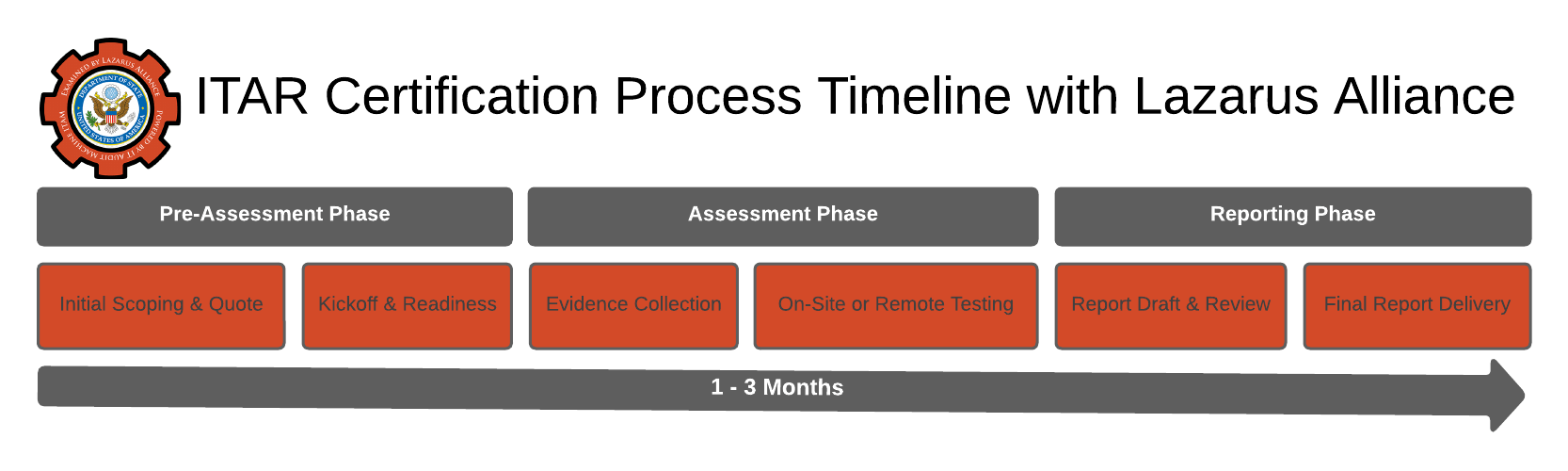
ITAR Audit Timeline: What to Expect with Lazarus Alliance
Lazarus Alliance delivers thorough, independent ITAR Compliance Audits tailored to your organization's size, complexity, defense article exposure, and current compliance maturity. While every audit is customized, the process typically follows a structured, efficient timeline to minimize disruption while maximizing value.
Our goal is proactive risk identification, clear remediation guidance, and a strengthened compliance posture, often in weeks rather than months.
ITAR Compliance Audit & Certification Timeline
with Lazarus Alliance • 4–12 Weeks End-to-End
Accelerated by up to 46% with our proprietary IT Audit Machine™ (ITAM) and Cybervisor™ advisory teams.
| Phase | Activities (ITAR Focus) | Typical Duration | Key Deliverables |
|---|---|---|---|
| 1. Pre-Engagement & Planning | NDA/SOW, kickoff, scope DDTC/ITAR requirements, upload TAAs & artifacts to ITAM | 3–5 business days | Approved SOW, RoE, ITAR readiness/gap report |
| 2. Gap Analysis | Full review of DDTC registration, technology control plan, training, recordkeeping, and screening | 1 week | Detailed gap analysis + prioritized remediation roadmap |
| 3. Evidence Collection | Automated/manual collection of policies, export logs, visitor records, and technical data controls | 1–2 weeks | Complete traceable evidence package in ITAM |
| 4. Assessment Execution | Virtual/on-site testing, interviews, configuration reviews, and simulated export scenarios | 2–4 weeks | Preliminary findings log + weekly dashboards |
| 5. Remediation & Validation | Findings review, client remediation, and re-testing of corrected controls | 1–2 weeks | Risk-rated POA&M + remediation validation report |
| 6. Final Reporting & Support | Delivery of the final report and optional continuous monitoring setup | 1 week | Final SAR, executive summary, and 24/7 ITAM portal access |
Typical ITAR Audit Timeline (Standard Engagement)
- Initial Consultation & Scoping (1–2 weeks)
- Kickoff call or meeting to discuss your operations, DDTC registration status, recent export activity, technical data flows, and key risk areas.
- We review high-level documentation (e.g., existing compliance manual, sample licenses/TAAs, organization chart).
- Define audit scope, objectives, timeline, team involvement, and any on-site/remote preferences.
- Deliver a formal engagement letter and project plan.
- Pre-Audit Preparation & Document Request (1–3 weeks)
- Lazarus Alliance provides a tailored document request list covering registration, classifications, licenses/exemptions, training records, access logs, policies, visitor logs, IT/security controls, and transaction samples.
- Your team gathers and securely shares materials (we use encrypted portals for sensitive data).
- Early risk screening helps focus fieldwork on high-priority areas.
- Fieldwork / On-Site or Remote Audit Execution (1–4 weeks)
- Interviews with key personnel (compliance officer, export control lead, IT/security, engineering, shipping/logistics, HR).
- Process walkthroughs and testing (e.g., sample transaction reviews, access control verification, technical data marking/storage checks).
- Risk-based sampling of 20–100+ recent transactions, licenses, exemptions, and records (scale depends on volume).
- Evaluation of physical/IT security, training effectiveness, recordkeeping (5-year retention), and internal monitoring.
- Duration varies: smaller organizations (limited USML items) often complete in 1–2 weeks; larger defense contractors with complex supply chains may take 3–4 weeks.
- Analysis, Draft Findings & Exit Briefing (1–2 weeks)
- Internal analysis of observations, gap identification, and risk rating.
- Draft report prepared with executive summary, detailed findings (strengths, non-compliances, potential violations), prioritized recommendations, and remediation roadmap.
- Exit meeting to walk through preliminary results, answer questions, and clarify any items.
- Final Report Delivery & Debrief (1 week)
- Issuance of the final, polished report (typically 20–50+ pages depending on scope).
- Includes compliance maturity rating, actionable remediation steps with suggested timelines, and alignment to DDTC best practices.
- Optional: management presentation or follow-up Q&A session.
Total Typical Duration: 4–12 weeks from initial consultation to final report delivery.
- Small to mid-size organizations with straightforward operations: often 4–8 weeks.
- Larger or more complex programs (high-volume exports, multiple sites, foreign nationals, cloud environments): 8–12 weeks or more.
This timeline assumes timely document submission and availability of key personnel; delays in providing materials or scheduling can extend phases.
Lazarus Alliance's approach emphasizes efficiency, minimal business interruption, and practical, business-aligned recommendations, not just findings. Our audits have helped clients demonstrate due diligence, strengthen internal programs, and confidently respond to DDTC inquiries or prime-contractor requirements.

Frequently Asked Questions
What is an ITAR assessment, and why is it important?
An ITAR assessment (often called an ITAR compliance audit or program review) is an independent evaluation of an organization's export compliance program, policies, procedures, classification practices, recordkeeping, training, and controls for handling defense articles, technical data, and services listed on the U.S. Munitions List (USML). It is important because the U.S. Department of State's Directorate of Defense Trade Controls (DDTC) strongly recommends regular assessments to identify gaps, mitigate risks, and demonstrate due diligence—potentially reducing penalties in case of violations.
What is the role of a 3PAO in ITAR assessments?
A third-party assessment organization (3PAO) like Lazarus Alliance provides independent, unbiased evaluations of an organization's ITAR compliance program. While ITAR does not mandate certification like CMMC, accredited 3PAOs deliver expert audits, gap analyses, risk assessments, and recommendations aligned with DDTC guidelines, helping organizations strengthen controls and prepare for potential DDTC scrutiny.
How does an ITAR assessment differ from simple DDTC registration?
DDTC registration (required under ITAR Part 122 for applicable companies) is a mandatory annual administrative step to engage in controlled activities. An ITAR assessment goes further by independently reviewing the effectiveness of your implemented compliance program, including classification accuracy, licensing processes, technology control plans, employee training, and internal audits—areas DDTC emphasizes for "staying in compliance."
How does ITAR compliance relate to other regulations like CMMC or DFARS?
ITAR focuses on export controls and protecting USML items/technical data from unauthorized foreign access (including "deemed exports"). It often overlaps with CMMC (which protects Controlled Unclassified Information in DoD contractor systems) or DFARS requirements. A comprehensive ITAR assessment can help align controls across these frameworks, especially for defense contractors handling both ITAR-controlled and CUI data.
Can an ITAR assessment help reduce penalties for potential violations?
Yes—having a strong, assessed compliance program (including third-party validation) is a mitigating factor in DDTC enforcement actions. Organizations with documented assessments and corrective actions often face reduced civil or criminal penalties compared to those without effective programs.
What are the benefits of using an accredited 3PAO like Lazarus Alliance for an ITAR assessment in 2026?
An accredited 3PAO provides objective expertise, experience with DDTC expectations, and often cross-compliance insights (e.g., with related frameworks like NIST or CMMC). Lazarus Alliance, known for its work in federal compliance areas, delivers thorough, defensible reports that help demonstrate proactive compliance to primes, customers, or regulators, while identifying practical remediation steps.
How often should an organization conduct an ITAR assessment?
DDTC recommends regular internal audits and periodic third-party assessments as part of a robust compliance program. Many organizations perform assessments annually, biennially, or after significant changes (e.g., mergers, new product lines, or expanded foreign interactions) to maintain ongoing compliance and address emerging risks.
What is the typical process for an ITAR assessment with a 3PAO?
The process generally includes: scoping discussions and document requests; on-site or remote review of policies, records, and systems; interviews with key personnel; testing of controls (e.g., classification, access restrictions); identification of findings/gaps; a formal report with recommendations; and optional follow-up support for remediation.

Credentials You Can Count On
American Association for Laboratory Accreditation (A2LA) ISO/IEC 17020 accredited certification number 3822.01
Talk with one of our experts
Our Lazarus Alliance Cybervisor™ teams have experience performing thousands of assessments for organisations providing services to clients around the world.
We're here to answer any questions you may have.

Benefits of ITAR Compliance
Maintaining ITAR compliance (International Traffic in Arms Regulations) provides significant strategic, legal, operational, and reputational advantages for organizations involved in the defense, aerospace, manufacturing, or export of items on the United States Munitions List (USML). These benefits extend beyond mere regulatory adherence; they position compliant companies as reliable partners in a highly regulated industry.
Here are the key benefits of ITAR compliance:
- Access to Lucrative Government and Defense Contracts: ITAR compliance is often a prerequisite for bidding on or winning U.S. Department of Defense (DoD) contracts, subcontracts with prime contractors, and other high-value opportunities in the defense supply chain. Non-compliant entities are frequently disqualified, while compliant ones gain eligibility and a competitive edge in securing these contracts.
- Avoidance of Severe Penalties and Legal Risks: Compliance helps prevent devastating consequences of violations, which can include civil fines up to $500,000–$1,000,000 per violation, criminal penalties (including up to 20 years imprisonment), loss of export privileges, debarment from future ITAR activities, and reputational damage. A strong compliance program serves as a mitigating factor in any enforcement actions by the Directorate of Defense Trade Controls (DDTC).
- Enhanced National Security and Protection of Sensitive Technologies: By controlling exports, imports, and access (including deemed exports to foreign persons), ITAR compliance safeguards U.S. military advantages, prevents proliferation of advanced technologies to adversaries, and supports broader U.S. national security and foreign policy goals.
- Strengthened Reputation and Trust with Stakeholders: Demonstrating commitment to ITAR standards builds credibility with government agencies, prime contractors, customers, and partners. It signals reliability, ethical practices, and robust protection of sensitive data/intellectual property—often leading to stronger business relationships and preferred supplier status.
- Competitive Advantage in the Defense Marketplace: Compliant organizations stand out as trusted partners for sensitive projects. This differentiation can result in higher contract win rates, increased revenue growth (e.g., reported advantages like 12% annual growth vs. lower for non-compliant peers), and better positioning in bids involving international collaborations or allied defense programs.
- Improved Internal Security and Operational Practices: Implementing ITAR requirements (e.g., classification, licensing, recordkeeping, training, technology control plans, and access controls) often drives broader improvements in cybersecurity, data protection, documentation workflows, and risk management, making the entire organization more resilient against threats.
- Risk Mitigation for Intellectual Property and Business Continuity: Compliance protects proprietary technical data and defense articles from unauthorized foreign access or diversion, reducing the risk of IP theft, competitive disadvantages, or business disruptions from enforcement actions.
- Facilitated International Opportunities (with Proper Controls): While ITAR restricts unauthorized transfers, compliance enables controlled exports to approved allies/partners, supporting global supply chains, collaborations, and market expansion under licensed conditions, without the full barriers faced by non-compliant entities.
- Demonstration of Due Diligence and Maturity: A mature ITAR program (including regular assessments and internal audits) shows proactive risk management to regulators, primes, and auditors. This can reduce scrutiny, speed up approvals, and serve as evidence of effective controls in related frameworks (e.g., overlaps with DFARS, NIST, or CMMC).
- Long-Term Business Resilience and Cost Savings: Proactive compliance avoids costly remediation, legal fees, lost contracts, or operational halts from violations. It also fosters a culture of accountability and excellence, turning regulatory obligations into operational strengths.
In summary, ITAR compliance is not just a legal obligation; it's a foundational element for success in the defense sector, protecting national interests while delivering tangible business value.
If you're evaluating ITAR needs for your operations, consider your specific activities (e.g., manufacturing, exporting, or brokering) and reach out to the DDTC or a compliance specialist for guidance.