
CTPAT Audit Services & Compliance Assessments from Lazarus Alliance. Call +1 (888) 896-7580 today!
Table of Contents
Toggle
The U.S. Customs and Border Protection (CBP) administers the Customs-Trade Partnership Against Terrorism (C-TPAT) program. Its Minimum Security Criteria (MSC) outlines the security standards that participating companies (such as importers, exporters, carriers, and others) must meet or exceed to maintain certification.
The current MSC, implemented in 2020 following a major revision in collaboration with the trade community, is organized into three main focus areas with 12 core categories. These apply across entity types, though specific implementations vary (e.g., separate guidance exists for importers, highway carriers, foreign manufacturers, etc.). Many requirements are designated as "must" (mandatory) or "should" (recommended based on risk assessment).
Focus Areas and Categories
- Corporate Security
- Security Vision & Responsibility (senior management commitment, dedicated resources, and a written security policy).
- Code of Conduct (publicly available and addressing ethical standards).
- Risk Assessment
- Conducting periodic supply chain risk assessments, including threat analysis for countries, routes, and business partners.
- Business Partners
- Screening, selecting, and monitoring business partners (e.g., suppliers, vendors) to ensure they meet C-TPAT or equivalent security standards.
- Cybersecurity
- Protecting IT systems from unauthorized access, including policies for passwords, access controls, data protection, and cybersecurity training.
- Physical Security
- Securing facilities, cargo storage, and assets with measures like fencing, lighting, locks, alarms, and surveillance systems.
- Physical Access Controls
- Controlling access to facilities and sensitive areas via badges, visitor management, employee screening, and monitoring.
- Personnel Security
- Pre-employment screening, background checks (where permissible), periodic re-verifications, and termination procedures.
- Education, Training, and Awareness
- Ongoing security training for employees, covering threats, procedures, and recognition of risks like contraband or terrorism indicators.
- Transportation Security
- Procedures for conveyance (e.g., trucks, ships) security, including seals, inspections, and tracking.
- Container and Trailer Security
- Inspection procedures (e.g., 7-point or 17-point inspections), sealing, and storage to prevent tampering.
- Instrument of International Traffic Security
- Security for containers, trailers, and other equipment used in international trade.
- Procedural Security
- Documenting and verifying cargo processes, including manifest accuracy, bill of lading procedures, and incident response.
- Incident Response and Recovery
- Having plans for security incidents, including internal analysis and reporting to CBP when required.
- Agricultural Security (where applicable)
- Measures to prevent contamination or infestation in agricultural shipments.
Additional requirements include a strong emphasis on risk-based implementation, documentation of policies and procedures, and regular self-assessments. Companies must also address emerging threats like cybersecurity and agricultural risks more explicitly than in previous versions.
For the most detailed and entity-specific requirements, review the official MSC documents on the CBP website (available via the C-TPAT Portal or public pages), as they are periodically refined. The criteria have remained stable since the 2020 rollout, with no major updates announced as of late 2025.
CTPAT Audit Services by Lazarus Alliance
A CTPAT audit from Lazarus Alliance is a third-party assessment that evaluates your organization's compliance with the U.S. Customs and Border Protection (CBP) Customs-Trade Partnership Against Terrorism (CTPAT) program's Minimum Security Criteria (MSC). Our experts review security policies, procedures, and practices in key areas, including physical security, cybersecurity, personnel screening, and supply chain risk management. The audit includes documentation reviews, site or virtual assessments, interviews, and risk-based testing to identify vulnerabilities and confirm alignment with CBP requirements. The process typically completes in up to 10 days, delivering actionable findings and recommendations to support or maintain your CTPAT certification.
Lazarus Alliance excels in CTPAT program implementation and ongoing support. We employ a proactive, risk-based, top-down approach to enhance both efficiency and effectiveness in your security programs.
We integrate our proprietary Continuum GRC platform—a cloud-native Governance, Risk, and Compliance (GRC) SaaS portal (including the IT Audit Machine or ITAM module)—to accelerate CTPAT audits and compliance:
- Core Role: Provides 24/7 client access for real-time collaboration, document management, evidence collection, and assessment tracking.
- Key Benefits for CTPAT:
- Delivers an average 46% reduction in traditional assessment time through automation, critical-path methodologies, and proactive tools.
- Assists in creating and maintaining essential CTPAT documentation, such as System Security Plans, policies, procedures, and risk evaluations aligned with CBP's MSC.
- Supports efficient risk-based audits with gap analysis, vulnerability identification, and remediation guidance.
- Enables continuous compliance monitoring and streamlined preparation for CBP submissions, including Security Assessment Reports (SAR).
Upon completion, Lazarus Alliance delivers an independent third-party Security Assessment Report (SAR). This comprehensive report outlines your security controls, testing procedures, results, findings, and mitigation recommendations, fully aligned with CTPAT's Minimum Security Criteria. You can submit it directly to CBP for certification or revalidation, or share it with stakeholders to demonstrate robust supply chain security compliance. We also provide an engagement affidavit for marketing and customer assurance purposes.
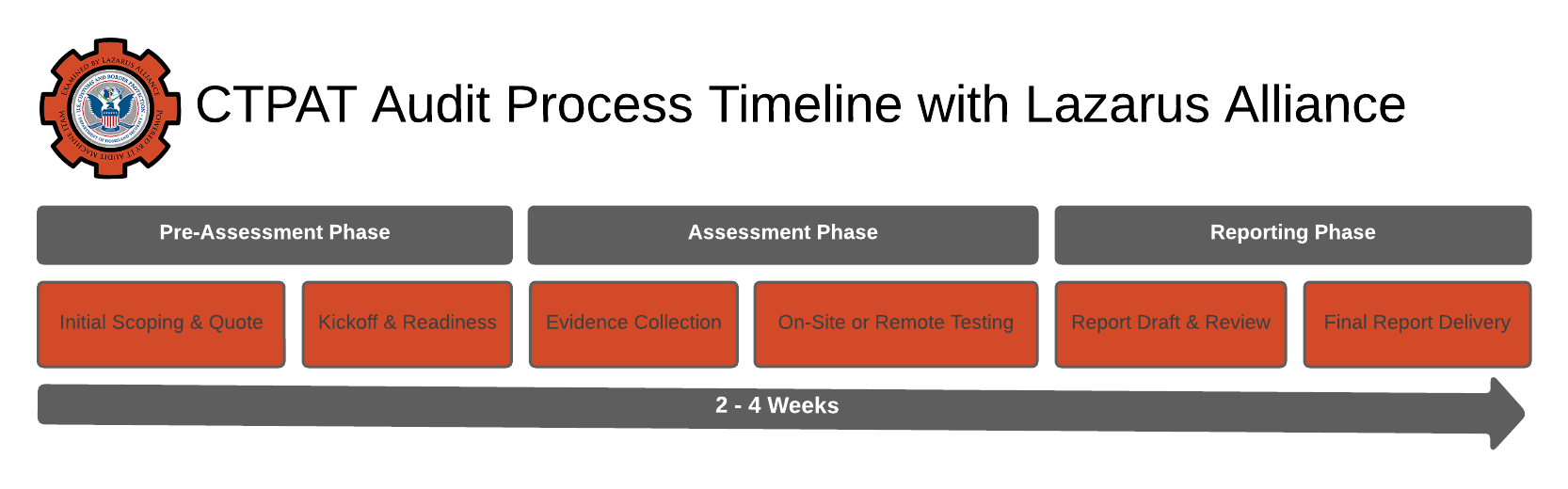
Basic Timeline: Working with Lazarus Alliance for Customs-Trade Partnership Against Terrorism (C-TPAT) Audit
A basic timeline for a C-TPAT audit with Lazarus Alliance is efficient and risk-based, leveraging their proactive methodology, Cybervisor™ experts, and tools like the Continuum GRC portal for faster completion. While exact durations vary by organization size, readiness, and scope, the core third-party audit process typically follows this structure:
- Initial Consultation and Planning (1-3 days to 1 week): Contact Lazarus Alliance (e.g., via +1 (888) 896-7580) for a Cybervisor™ consultation. This includes scoping the engagement, reviewing your current security profile, and preparing documentation (e.g., policies, System Security Plans). Their platform enables 24/7 access to streamline preparation.
- Documentation Review and Preparation (Ongoing, leading into audit): Lazarus Alliance assists with developing or refining required materials aligned with CBP's Minimum Security Criteria (MSC). This phase overlaps with planning and benefits from their tools for efficiency.
- On-Site or Virtual Assessment (Typically 5-10 days): The main audit involves evaluating security controls through documentation reviews, site/virtual visits, interviews, and risk-based testing (covering areas like cybersecurity, physical security, and supply chain risks). Lazarus Alliance states the process typically takes up to 10 days, with an average 46% reduction in traditional assessment time thanks to their critical-path approach and automation.
- Reporting and Remediation Recommendations (Immediate to 1-2 weeks post-audit): Receive an independent Security Assessment Report (SAR) detailing findings, testing results, vulnerabilities, and mitigation steps. This SAR can be submitted to CBP for certification or revalidation. An engagement affidavit is also provided for marketing/compliance demonstration.
- Submission to CBP and Ongoing Support (Variable): You submit the SAR to U.S. Customs and Border Protection. CBP typically reviews within weeks to months. Lazarus Alliance offers continuous support for remediation and future compliance.
Overall, the Lazarus Alliance-led audit can often be completed in under 2-4 weeks from start to report (faster than traditional methods), depending on your team's availability and preparedness. For a personalized timeline, reach out directly to their team.

Frequently Asked Questions
What is C-TPAT?
C-TPAT (Customs-Trade Partnership Against Terrorism) is a voluntary public-private partnership program led by U.S. Customs and Border Protection (CBP). It requires participating organizations to implement robust security policies and procedures to meet CBP's Minimum Security Criteria (MSC), ensuring supply chain integrity and protection against terrorism risks.
What are the key benefits of C-TPAT certification?
C-TPAT certification helps minimize supply chain risks, demonstrates compliance to stakeholders, and provides access to benefits like reduced inspections and faster border crossings. Lazarus Alliance audits also deliver an independent Security Assessment Report (SAR) and engagement affidavit for marketing and customer relations.
Who is eligible for the C-TPAT program?
Eligible participants include U.S. importers, exporters, carriers, customs brokers, and other trade entities involved in international supply chains. Organizations must commit to meeting CBP's security requirements, and Lazarus Alliance assists with implementation and compliance for companies of all sizes.
What are the Minimum Security Criteria (MSC) for C-TPAT?
The MSC are CBP standards covering areas such as physical security, cybersecurity, personnel screening, supply chain risk management, and more. Organizations must align their policies, procedures, and practices with these criteria through regular assessments and validations.
How does the C-TPAT certification process work?
The process involves applying through CBP, implementing security measures, and undergoing assessments or validations. Lazarus Alliance conducts third-party audits (including documentation reviews, site/virtual visits, and risk evaluations) that typically take up to 10 days, resulting in a detailed SAR for submission to CBP.
How can Lazarus Alliance help with C-TPAT compliance?
Lazarus Alliance provides expert C-TPAT audit services, including compliance assessments against MSC, documentation development (e.g., policies and System Security Plans), risk-based evaluations, and ongoing support. They use a proactive, top-down approach and tools like the Continuum GRC portal for efficient results.
What happens during a Lazarus Alliance C-TPAT audit?
The audit evaluates your security controls through documentation review, site or virtual assessments, and vulnerability identification. It follows a risk-based methodology, provides findings with mitigation recommendations, and produces an independent SAR aligned with CBP requirements.
How do I get started with Lazarus Alliance’s C-TPAT services?
Contact Lazarus Alliance at +1 (888) 896-7580 to speak with a C-TPAT Cybervisor™. They offer consultations, implementation support, and continuous compliance monitoring to help achieve and maintain C-TPAT certification efficiently.
Credentials You Can Count On
American Association for Laboratory Accreditation (A2LA) ISO/IEC 17020 accredited certification number 3822.01.
Talk with one of our experts
Our Lazarus Alliance Cybervisor™ teams have experience performing thousands of assessments for organisations providing services to clients around the world.
We're here to answer any questions you may have.


Benefits of Customs-Trade Partnership Against Terrorism (C-TPAT) Compliance
Participating in the Customs-Trade Partnership Against Terrorism (C-TPAT) program, a voluntary initiative by U.S. Customs and Border Protection (CBP), offers certified members (importers, exporters, carriers, and others) significant advantages in supply chain security, efficiency, and trade facilitation. Benefits vary by entity type and Tier level, but key ones include:
- Reduced Inspections and Faster Border Crossings — C-TPAT members are considered low-risk, resulting in fewer CBP security or compliance examinations (often 4-6 times less likely than non-members). Shipments receive priority processing, shorter wait times, and "front-of-the-line" privileges if selected for inspection.
- Access to Expedited Lanes — Eligible highway carriers can use Free and Secure Trade (FAST) lanes at U.S.-Canada and U.S.-Mexico borders for quicker crossings.
- Assigned Supply Chain Security Specialist — Members get a dedicated CBP liaison for ongoing support, validations, security guidance, training, and updates.
- International Recognition via Mutual Recognition Arrangements (MRAs) — C-TPAT status is recognized by partner countries (e.g., Canada, Mexico, EU, Japan, and others), potentially providing reciprocal benefits like reduced inspections abroad.
- Priority in Disruptions — Business resumption priority after natural disasters, terrorist attacks, or other events, plus expedited entry for shipments.
- Eligibility for Other Programs — Access to U.S. government pilots (e.g., FDA Secure Supply Chain) and, for importers, the separate CTPAT Trade Compliance program with additional perks like penalty mitigation and advanced hold notifications.
- Enhanced Supply Chain Security and Risk Mitigation — Strengthens overall security (e.g., against terrorism, theft, or contraband), improves vulnerability identification, and fosters best practices in areas like cybersecurity and physical access controls.
- Market and Reputational Advantages — Demonstrates commitment to security, serving as a marketing tool to attract customers/partners who prefer C-TPAT-certified suppliers, and potentially reducing costs from delays or theft.
These benefits help balance robust security with efficient trade, with over 11,400 partners currently enrolled. For the latest details specific to your business type, consult the official CBP C-TPAT portal or a Supply Chain Security Specialist.